


COMPUTATIONAL MATERIALS SECTION
Overview
The Computational Materials Section at CSIR-CGCRI develops and applies advanced modelling and simulation methods to understand, predict, and design new materials. Developing materials with targeted properties by trial and error is slow and costly, particularly when the space of possible compositions and structures is vast. The section addresses this challenge by combining physics-based modelling with data-driven methods, working closely with the institute’s experimental groups and with academic researchers across the country.
Material properties such as mechanical strength, optical response, and thermal and chemical stability ultimately come from structure and bonding at the atomic scale. The section’s work connects these length scales. Molecular dynamics (MD) simulations, using classical and machine-learned interatomic potentials, show how atomic arrangements, network topology, and dynamics control the behaviour of disordered and crystalline materials, from structural relaxation and phase stability to plasticity and fracture.
Building on this, the section develops AI/ML models, including graph neural networks that learn directly from atomic structure, to capture composition–structure–property relationships. These models enable inverse design, in which generative models and Bayesian optimisation start from target properties and propose candidate materials for experimental validation. Density functional theory (DFT) complements this with insight into electronic structure, chemical bonding, and defect energetics, and provides high-fidelity data for training machine-learned potentials.
At the component scale, finite element analysis (FEA) uses material properties from simulation and experiment to predict stress distribution, thermal and residual stresses, deformation, and failure under realistic operating conditions. This lets designs be tested and optimised virtually, reducing costly prototyping.
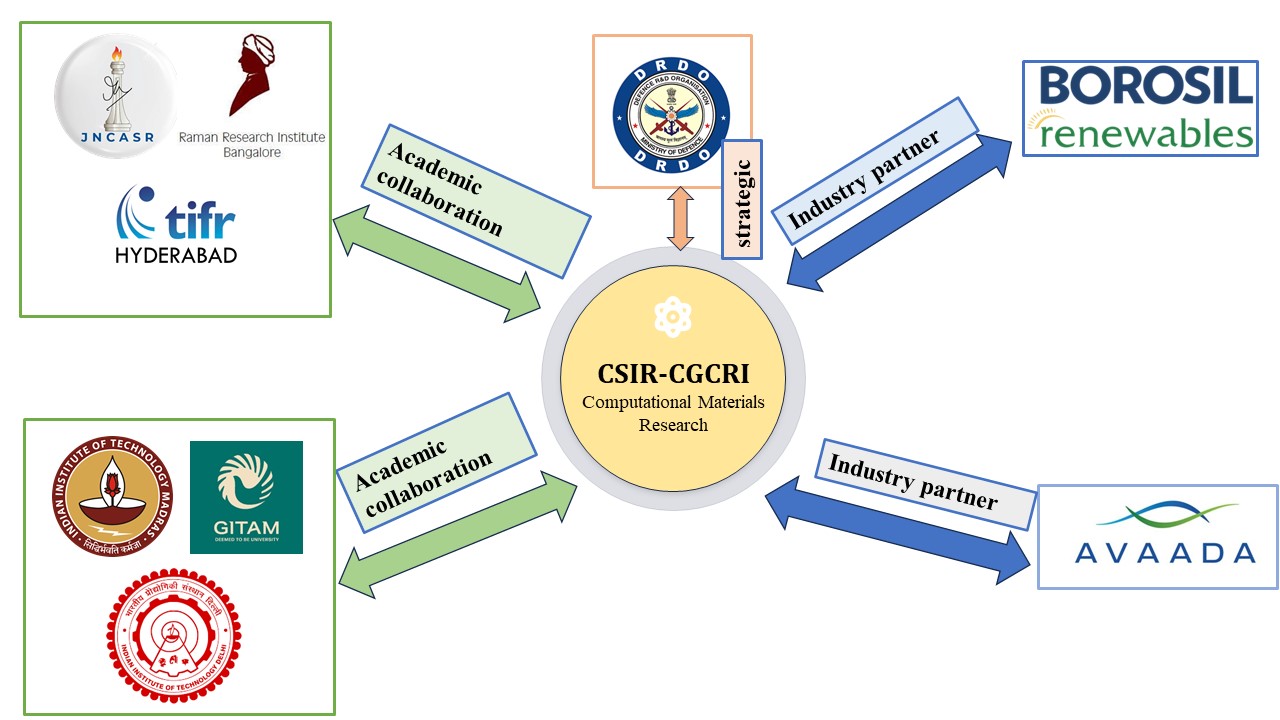
The work is supported by the institute’s high-performance computing facility and carried out in collaboration with experimental groups, academic researchers across the country, and industry.
Mission
The mission of the Computational Materials Section is to speed up the discovery and design of advanced materials through predictive modelling grounded in statistical mechanics and quantum mechanics and strengthened by artificial intelligence. By linking atoms to applications, from electronic and atomic-scale mechanisms to the performance of engineered components, the section aims to turn fundamental scientific insight into practical materials solutions for national priorities in energy, photonics, healthcare, and strategic sectors.
GOALS
We aim to accelerate materials discovery by uniting AI-driven design, atomistic simulation and component-scale virtual testing with the Institute’s experimental expertise. Our work focuses on understanding how structure governs properties, guiding synthesis and processing, and advancing sustainable materials. We also train the next generation of researchers and provide high-performance computing resources to the wider community.

Inverse design of new materials
Develop AI/ML-driven frameworks, including generative models, graph neural networks, and Bayesian optimisation, that start from target properties and identify promising compositions and structures for experimental validation.

Supporting experiments
Provide theoretical and computational support to the institute’s experimental groups, helping interpret measurements and guide synthesis and processing.

Sustainable materials
Apply computational design to energy-efficient, durable, and environmentally responsible materials and processes.

Understanding mechanisms at the atomic scale
Use large-scale molecular dynamics and density functional theory to uncover how structure, bonding, and dynamics govern properties such as strength, stability, transport, and fracture in disordered and crystalline materials.

Virtual testing at the component scale
Use finite element analysis to predict stress, deformation, and failure in real components, reducing the need for costly prototyping.

Capacity building
Train students and researchers in computational materials science through courses, workshops, and schools, and maintain high-performance computing resources for the research community.
AREAS OF RESEARCH

Deformation and failure prediction
Combining simulations with graph neural networks to predict plasticity and crack initiation in disordered solids directly from their structure.

AI/ML-driven materials design
Machine-learning, generative, and Bayesian optimisation models for inverse design of materials with targeted properties, along with data-driven platforms for materials search, visualization, and property prediction.

Atomistic simulations
Large-scale molecular dynamics of oxides, glasses, and ceramics to understand how atomic structure, bonding, and network topology control mechanical, thermal, and transport properties.

First-principles calculations and interatomic potentials
DFT studies of electronic structure, bonding, and defects, and development of classical and machine-learned interatomic potentials.

Finite element analysis and multiscale modelling
Component-scale prediction of stress, deformation, and failure, integrated with atomistic and ML models to link atoms to applications.

Statistical physics of disordered systems
The glass transition, relaxation, fragility, and dynamic heterogeneity, together with AI-assisted enhanced-sampling methods for complex energy landscapes.
INFRASTRUCTURE
High-Performance Computing Cluster
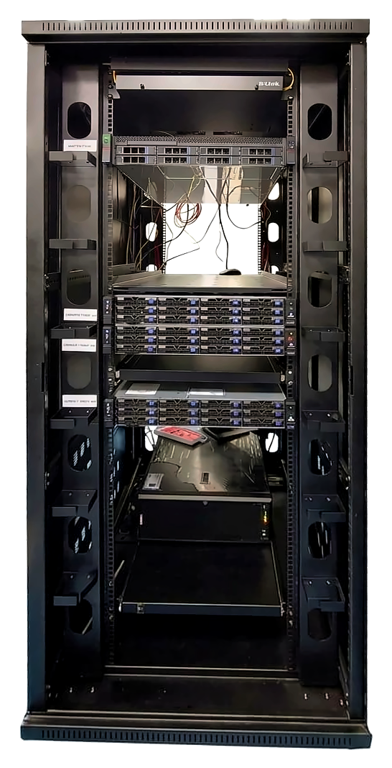
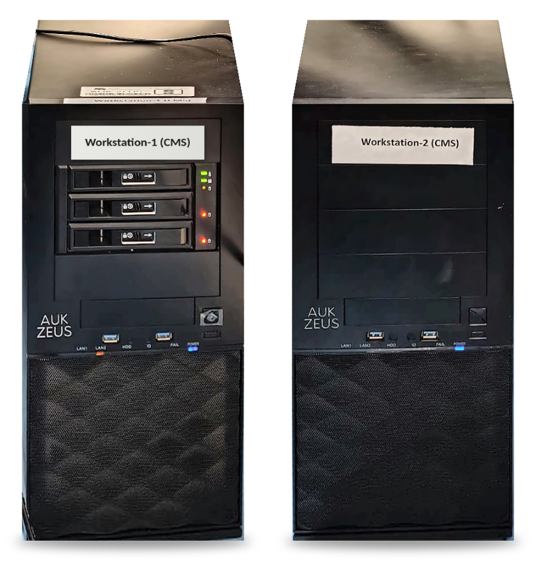
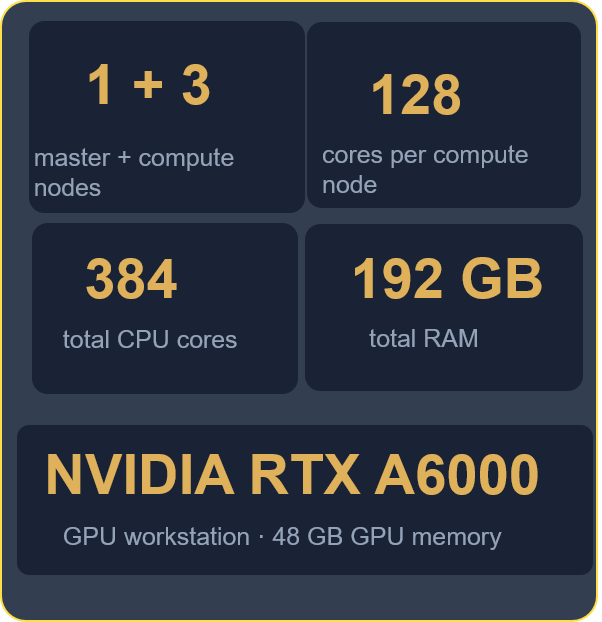
Our computational work runs on a dedicated in-house high-performance computing (HPC) cluster. It is built around one master node that manages scheduling and users, and three compute nodes with 128 cores each, giving 384 CPU cores for parallel work. With 192 GB of total system memory, the cluster supports large-scale, computationally demanding simulations. It is complemented by a dedicated GPU workstation with an NVIDIA RTX A6000 card for training machine-learning and generative AI models and for GPU-accelerated simulations.

SERVER RACK 01
SERVER RACK 02
WORKSTATION
CONFIGURATION
R&D SOFTWARE
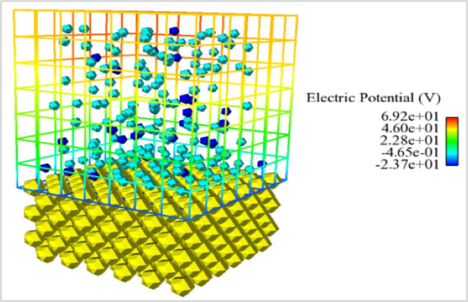
LAMMPS
Parallel molecular dynamics code for simulating glasses, ceramics, metals and polymers at the atomic scale.
GROMACS
High-performance molecular dynamics package for biomolecules, polymers and soft-matter systems.
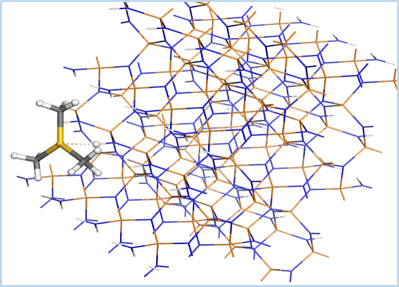
QUANTUM ESPRESSO
Open-source DFT suite for electronic structure, total energies and first-principles materials modelling.
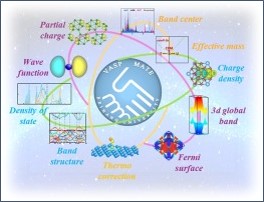
VASP
Plane-wave DFT code for electronic structure, defect energetics and first-principles molecular dynamics.
COMSOL MULTIPHYSICS
Finite element platform for coupled thermal, mechanical, electrical and fluid-flow simulations.
KEY STAKEHOLDERS
Last Updated on October 13, 2026
